Saturday, September 18, 2010

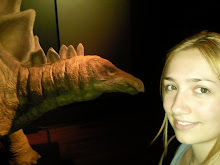
I love you, Spike

Stegosaurus Week (13th Sept to 19th Sept) is coming to a close, and I haven't made a single mention about the Stegosaurus.

For those who don't know, Stegosaurus was a herbivour which first appeared in the Jurassic (and probably had epic battles of survival against Allosaurus). The most commonly identified of the Stegosauridae family is most likely Stegosaurus stenops, since nearly everywhere I look (if you're searching for dinosaurs as much as I am), S. stenops is almost like the posterchild for what a Stegosaurus species is characterised for. It was short and stocky, but with large plates and typical 4 spikes on the end of the tail. Although, it wasn't the largest stegosaurid, it does seem to be the most common species.

So why is Stegosaurus so awesome??
Besides the clearly lethal set of tail-spikes Steg sported, and the pretty cool looking fashion statement they made during the Jurassic with their plate(-like Mohawks), there is one really awesome thing about Stegosaurus:

It had a "second brain"; near the base of its tail used for controlling reflexes in the rear part of its body. The "brain" in the hip region was not made of brain tissue, but instead, a complex nerve centre; the "sacral plexus." It was a secondary control center for the spinal cord. So despite the obvious tiny size of Stegosaurus' brain, and the possibility that it may have lacked intelligence, didn't mean it wasn't cleverly designed for its time in an evolutionary time-frame.

Saturday, September 11, 2010

Feathery upset

I had this journal article in Nature brought to my attention; and low and behold! It has my favourite palaeoartist, Raul Martin's interpretation of this amazing predator, Concavenator corcovatus...


Interesting features of this 130 million year old predatory dinosaur:
(1) a strange hump on its back; and
(2) unusual calcareous lumps on its forearms (believed to bear quills - a possible evidence of feathers).

The eleventh and twelfth vertebrae are more prominent, being double the height of the rest of the vertebrae. This pyramidal crest may have been used in territorial disputes and/or attracting a mate, or even similarly used in a manner resembling Stegosaurus' plates. (To me, it looks like an ideal, gentle slope where a male Concavenator could rest his chest while romancing the lady... but that's my outlandish observation).
At this point, all we can gather is Concavenator is a rather strange specimen.

Now the bumps on the forearms is even more controversial than the odd triangular hump. So the problem here is this... C. corcovatus provides evidence that feathers began to appear earlier than previously thought. Which now puts a little twist in the Therapod family tree, as Concavenator is more closely related to "Big Al" (MOR 693) which, up until now, have never had a feathery relative. The sister lineage which has the feather-featuring dinosaurs (T. rex) and finally leading to modern-day birds has now been thrown into shambles over the rights to bear plumage.


Tuesday, August 31, 2010

Vintageosaurus mistakeii

Reconstruction of Laelaps (now known as Dryptosaurus) - by Edward Drinker Cope - possessing a typical (at the time) vertical posture, slouching head and useless arms. Image from Love in the time of Chasmosaurus

We occasionally make mistakes. Everyone can think of at least one major mistake they've made during their career (undoubtedly we make a couple in our personal lives which we may or may not wish to recall). But I want to look into some memorable vintage palaeo mistakes. . . the ones generally made when there is nothing in the known world (19th century known world) that can be comparable to the discovery of massive "lizard bones":

Iguanodon
Most people will recognise this dinosaur more than the first palaeo reconstruction mistake, Megalosaurus. The first reconstruction of iguanodon was the huge iguana-like statue which still stands at Crystal Palace, south London, by Benjamin Waterhouse Hawkins. The "thumb spike" was placed on the tip of the snout, creating a more lizard-like appearance. In some aspects, Hawkins' iguanodon resembles a horned, very toothy chameleon.
The initial reconstruction of Iguanodon by Hawkins, and the current corrected version by Raul Martin.

Apatosaurus (formerly Brontosaurus)
The
Apatosaurus went through many changes, but one of the more notable was the correction of its skull. For many years until 1975, the poor sauropod borrowed the skull of a distantly related cousin, Camarasaurus - more closely related to Brachiosaurus. The contrast in the two skull types are quite astounding.


Left is the Camarasaurus skull, which for years was placed upon the body of "Brontosaurus", the skull on the right is that of a Diplodocus, a close relative of Apatosaurus (NE: Brotosaurus) and displays what the skull of Apatosaurus should have been like. Image from Taylor, M.P., Wedel, M.J., Naish, D. 2009. Head and neck posture in sauropod dinosaurs inferred from extant animals. Acta Palaeontologica Polonica, 54(2): 213-220

Posture, poise and grace

For most dinosaurs, the position of the legs and the weight-bearing stance was often incorrect.
Tyrannosaurus, Iguanodon, Triceratops, Stegosaurus and even large sauropods have all fallen at the unbalanced positioning of their limbs and tails. Tyrannosaurus, for example, for many years had been depicted as near vertically erect like an alert meerkat and balanced precariously on its tail (which dragged along the floor similarly to sauropods depicted around the early 20th century). In the case of the sauropods, (such as Diplodocus) they were occasionally illustrated with bow-legs; dragging their enormous bulk through the dirt, long tail limp behind them. Due to this hefty burden, most sauropods were placed in an aquatic setting to allow them more buoyancy. Providing evidence in the fact that poor teaching and a long-standing reliance in religion and Creationism doesn't achieve results in reality.

The reason for bringing up some of the errors in palaeontology (and particularly reconstructions) is in showing that when first uncovered, after the initial analysis and subsequent recording of characteristics and features, not everything about a specimen will be correct. More often than not, since science is forever updating its knowledge and techniques, things which may not have been considered important may, in fact, turn out to be the exact source of information which could completely alter the definition of that specimen... as an example, I turn your attention to BMRP 2002.4.1 "Jane"... (in my heart, always a Nanotyrannus), or maybe the example of the absorption of Stygimoloch and Dracorex as individual species into different growth stages of Pachycephalosaurus would be for better understanding.

Monday, August 30, 2010

"Bird brain"... not such an insult


So, I was going through the TED library of film clips for something interesting to watch and I stumbled upon this piece of gold: Einstein the Parrot.

This was as equally impressive as the documentary I saw of Alex the African Grey who passed away in 2007 at age 31. The vocal range of these guys is amazing and the understanding and recognition of commands and simple words and phrases is really impressive. But the brains don't end at the African Grey Parrot. . .

The kea, (possibly my favourite parrot of mischief) a large New Zealand parrot, have also been know for their intelligence. They've been observed to become destructive (damaging cars, bins, and home roofing), disruptive and bored whilst in captivity; requiring mental stimulation in the form of rather complex puzzles.

Tuesday, August 10, 2010

One Year On


As I sit in those moments of quiet,
When sadness invades me,

I know that yesterday,

You were here.

Now you are away from us,

Not knowing your future,

Or when you'll come home, but yesterday,

You were here.


It has now been a week,

A week since you last were in the house,

An entire week since we carried you away,

To the place where we did not know your future,
but just last week,
You were here.


Another day passes;

A week ago, you were still with us,

In daily reports from the clinic,

They did not know your future, But we could still hope, and,
You were here.


More days pass,;

A week ago you left us,

Your head cradled in our hands,

Your spirit gracefully moving upward,

But for a few hours of that day,

You were here.

Sadness invades again,

As I know that once those hours pass,

I can no longer look back,

Over the span of a familiar week's time,

To find that comforting point when,

You were here.


More time will pass;

Sadness will not so much invade as menace,

And I will mark the days,
Saying things like,
"last month, last summer, last Halloween, last year,"
You were here.


I dread that day,

One year from now,
That first marking of the time,
That your body was no longer with us;
Though we will never forget you,

Your tangible memory fades,

The feel of your fur, your head, your back, your weight against us,

The smell and sounds of you when,

You were here.

The emptiness is beginning to fade,

To change into another reality,
One with you still playing a part,

But a role of ethereal presence rather than physical comfort we crave;

Your memory, your spirit, your essence and counsel,

Dwell with us, but this feeling is not the same as when,

You were here.

--"You were here" by Jenine Stanley

--------------------------------------------------------------------------

A year ago today, I said goodbye to you for the last time. I held you and pleaded to keep you longer if you were willing. You were too weak, and I knew I was being selfish. It felt like the longest drive, and when we arrived, I wished it had taken longer. I carried you in your blanket; you didn't fight... I knew by then that you had given up. I lay you on the table, the Vet came in to see us. Not once did I stop holding you - but she had to take you away through the back door. You weren't gone long, but you came back ready to leave. I held you again and whispered in your ear, and then your legs gently buckled and you got very heavy. You lay there, head slumped in my hand; and I closed your eyes. The Vet checked your vitals and announced "She's gone now". I cried. If love alone could have saved you, you never would have died.

I still cry, but maybe not as much.

I know I have my memories... but I only wanted you. You're my best friend and were always there for me through the hard times. I miss having you there... with all your quirks and love and life. You were more than a cat to me, I grew up with you forever by my side. You'll always have a special place in my life and I'll always love you for how you were and not how you left.

Forever loved; Always missed
Krystal
"Seal Moosh"

xoxoxo

Saturday, July 10, 2010

CELLS: for the microbiologist in you

The new time waster for me also happens to be a necessary source of scientific revision :) This is a very "cool" (yet nerdy) free online game for the microbiologist in us all... or the science student who requires unique ways in learning cellular function...

Friday, July 9, 2010

Happy birthday Goose

It happens to be someone's birthday today... yes, that's you Ben (special enough to elicit a blog out of me). I thought I'd point out the other miraculous happenstances surrounding your birthday some 23 years ago to the day... you know, for reminiscent sake.

During July 9th, 1987:
-- "Light-induced colour changes by the iridophores of the Neon tetra, Paracheirodon innesi" by Clothier, J. & Lythgoe, J.N. was published in the Journal of Cell Science.
-- It was a Thursday

During July 1987:
-- I Wanna Dance with Somebody (Who Loves Me) by Whitney Houston was the number 1 single in Australia for 5 weeks starting in June.
-- Movies of note during July, '87 include "La Bumba", "Jaws 4: Revenge", "Revenge of the Nerds II: Nerds in Paradise", "Superman IV: The Quest for Peace" and "RoboCop"

During 1987:
-- Susumu Tonegawa won the Nobel Prize for his discovery of the genetic principle for generation of antibody diversity
-- Most popular boy's name this year = Michael
-- Most popular girl's name this year = Jessica
-- Most noted cartoons include "The Care Bears", "Smurfs", "Thundercats", "Alf", "Transformers" and "Jem & the Holograms"

During July 9th (any year):
-- Sir George Howard Darwin (one of Sir Charles Darwin's sons) was born this day in 1845. He posed the theory that the moon was once part of the Earth and was the first to mathematically analyse the evolution of the Earth-moon relationship and solar tides.
-- In the Battle of Normandy, British and Canadian forces capture Caen, France during WWII, 1944.
-- In 1816, Argentina declared its independence from Spain.
-- Henry VIII of England annuls his marriage to his fourth wife, Anne of Cleves in 1540.

HAPPY BIRTHDAY :)