Showing posts with label discovery. Show all posts

Saturday, June 16, 2012

Would make for an awkward family reunion

Acanthodes bronni. The species name has "bro" in it, and according to a study undertaken by Davis, Finarelli and Coates, the shark-like A. bronni is a member of the family.
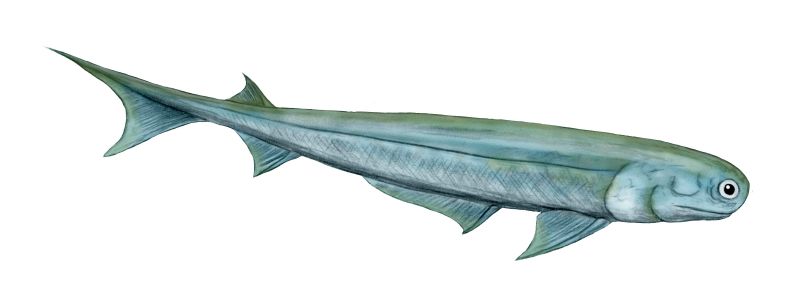
Wikipedia: Acanthodes bronni; your relative, a "few times" removed.
For an understanding of the position human beings find themselves in comparison to A. bronni, have a read of this blogger post: Common ancestor for humans and sharks: Acanthodes bronni. This post provides a brief history of the lineage and traits of Gnathostomes (everything with a spine and jaws).

Love your Brother shark.


Sunday, April 15, 2012

Cuddlysaurus: where fluffy IS deadly

Cuddly-looking, fluffy and fuzzy: not something you'd expect to describe a very large carnivorous mesozoic predator. BUT, there WAS a downy dinosaur. Yutyrannus huali, the tyrannosaurid with the fluffy coat, is the largest dinosaur discovered with a full covering of feathers.

Y. huali was uncovered in China, and estimated to be 60 million years older that its famous cousin, Tyrannosaurus rex. Although considerably feathered, the immense bulk of the predator would not have been very aerodynamic - instead the down was purely for insulation, perhaps with a little splash of colour for display. It's not entirely odd for a predator to be feathered - snowy owls manage quite well in polar climates and their physiology is simply a downsized version of Yutyrannus.


(Image of Yutyrannus huali by Alain Beneteau aka dustdevil)

Info collected from these news articles here, here and here.
And this journal article in Nature.


Wednesday, January 11, 2012

Nicolas Steno: You old dinosaur

Today is Nicolas Steno's 374th birthday. For those of you who are unsure of who Steno is/was... I shall enlighten:

Steno was a scientist, but more importantly he was a geologist (and palaeontologist). He identified the relationship between glossopetrae (tongue stones) and the teeth of sharks to be one and the same, adding to an argument established by the late Fabio Colonna; the difference being, Steno noted differences between living shark teeth and those known to be glossopetrae (Owen, 2009). He is the father of the law of superposition, the principle of original horizontality, and the principle of lateral continuity; a basis for stratigraphy.


So, happy birthday, Nic! You old dinosaur.

Owen, D. 2009. Shark: In peril in the Sea, Allen & Unwin, Australia


In Dinosaur News:

PLoS ONE shared "New Ophthalmosaurid Ichthyosaurs from the European Lower Cretaceous Demonstrate Extensive Ichthyosaur Survival across the Jurassic–Cretaceous Boundary".

In brief, a 130 MY old ichthyosaur (
Acamptonectes densus) was discovered in Braunschweig, Germany. The sparkling, diamond-in-the-rough snippet of information you should dust off and take home should be that ichthyosaurs are "traditionally" from the Jurassic period; this specimen dates to the Cretaceous. How the ichthyosaur survived the JK event (mass(?) extinction) is beyond me... Oh, but wait! A.densus didn't survive the JK event... essentially, it, among other ophthalmosaurines and platypterygiines continued to thrive: "...diversity and disparity was reasonably high".

Anyway, to clarify what's so important about the "re-writing of pre-history" and what part this ichthyosaur played, I'd recommend reading the excellent ramblings of Darren Naish's blog post (co-author of the PLoS ONE article). There are some wonderful diagrams and anecdotal tidbits within.

Wednesday, November 30, 2011

Little Bix nursery

Protoceratops andrewsi nest from Mongolia - image from National Geographic, by Khishigjav Tsogtbaatar

Nawwww!

There's so many of them and they all so tiny and cute! If you have read Dinotopia by James Gurney, you'd know of Bix. For those who need a refresher course, Bix was a traveling dinosaur Ambassador and she was also a Protoceratops. The link here is that these little hatchlings are also Protoceratops, from Mongolia. A total of 15 youngsters were uncovered in a nest.

Will and Bix from James Gurney's Dinotopia

Protoceratops is a herbivorous, beaked dinosaur that lived over 85-70mya. It's the smaller cousin of Triceratops, but lacking facial horns. Its life-cycle is pretty well know due to the amount of fossil evidence of hatchlings, adolescents, and male and female adults.

image from Melbourne Museum

Protoceratops also lived along-side Velociraptor. This is famously noted in the "Dueling Dinosaurs", where a Protoceratops locked its beak tightly on the forearm of a velociraptor; the moment being frozen in time and sediment.


image of Dueling Dinosaurs by AMNH

Saturday, November 26, 2011

When they find one near Loch Ness, I'll be excited

MORE dinosaur news:


A nearly complete fossil of a plesiosaurus was uncovered by a Syncrude heavy equipment operator in an oil sands area, Alberta. It is believed to be around 40 million years older than other plesiosaur fossils, making it the oldest plesiosaur discovered to date.

image by Sue Sabrowski - Royal Tyrrell Museum

Thursday, November 24, 2011

No one is safe, not even Drop bears

I've been in a glass cage of emotion! No internets for weeks, which has made me feel very out-of-tune with the world... but the first thing I did read was the multiple murderous hippopotami in South Africa.

1. Farmer gouged to death by pet hippo Humphrey who was 'like a son to him'
2. Escape from the jaws of a hippo

While hippos are pretty dangerous in general, I was intrigued to know if there had been any honey badger attacks (specific aren't I). I didn't find any honey badger media but I did find this:

Koalas under attack from cows

Who'd have thought that a cow would be spooked by a koala enough to have a murderous streak. They are thuggish in their approach too. So watch out for the koalas, Eastern Staters. Next we'll be hearing about cows with guns...


Another article I found was this:


This is a new species, unknown to science referred to as a "ferret-badger". It's interesting looking enough. At first I thought they called it a ferret-badger because they had no idea which one it was more closely related to; then I did a little more research and found the strangest handful of cute, ferret-badgers. They look a little like Palm civets to me.

A species of Melogale, Chinese ferret-badger
(image from Scienceblogs)